.png)

Optimizing Cisco SD-WAN Routers with Secure Access SSL Decryption
The Growing Challenge of Encrypted Traffic in Modern Networks
Encryption is no longer optional; it is the default. The majority of enterprise traffic today is encrypted using SSL/TLS, which creates a visibility gap for security teams. While this protects data in transit, it also blinds traditional security controls, making it difficult to inspect traffic for threats such as malware, command-and-control callbacks, and data exfiltration.
In Cisco Catalyst SD-WAN environments, SSL decryption can be performed directly on edge routers. However, this approach introduces a significant trade-off: CPU-intensive decryption processes reduce overall throughput and impact application performance. As organizations scale, this model becomes increasingly inefficient and costly.
The Problem: SSL Decryption at the Edge
Catalyst SD-WAN edge devices are designed for routing, segmentation, and policy enforcement. When SSL decryption is added to the workload, several challenges emerge:
- High CPU utilization due to cryptographic processing -
- Reduced forwarding performance, especially under heavy traffic loads -
- Limited scalability, requiring hardware upgrades to maintain performance -
- Operational complexity when managing distributed security policies -
In real-world deployments, organizations often notice that enabling full SSL inspection on branch routers leads to degraded user experience, particularly for SaaS and cloud-based applications.
The Solution: Offloading to Cisco Secure Access
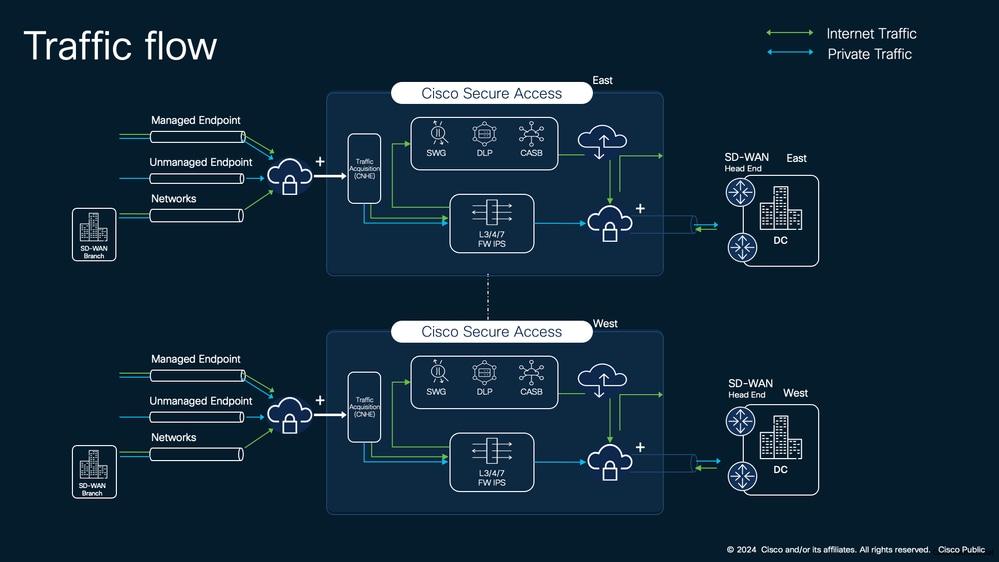
Cisco Secure Access introduces a cloud-delivered security architecture that fundamentally changes how SSL decryption is handled. Instead of processing encrypted traffic on-premises, decryption and deep packet inspection are offloaded to the cloud, where resources are elastic and purpose-built for security workloads. The result is a significant improvement in both network efficiency and security visibility.
This integration with Catalyst SD-WAN provides a more efficient and scalable model:
- SSL decryption occurs in the cloud, eliminating CPU strain on edge routers -
- Inline security services such as IPS, URL filtering, and malware protection are applied at scale -
- Traffic is optimized using secure service edge (SSE) principles, ensuring performance is maintained -
Centralized Security with a Unified Policy Model
One of the most impactful advantages of Cisco Secure Access is its centralized administrative control. Security teams can define and enforce policies across the entire network from a single console. For organizations managing hybrid environments, this centralized model eliminates silos between networking and security teams, aligning with Zero Trust principles.
This includes:
- Unified access policies for both internet-bound and private application traffic -
- Consistent security posture across branch, remote, and cloud users -
- Simplified operations, reducing the need for device-by-device configuration -
Real-World Use Case: Branch Optimization at Scale
Consider a distributed enterprise with hundreds of branch locations using Catalyst SD-WAN. Initially, SSL decryption is enabled locally at each site, leading to performance bottlenecks and increased hardware costs. This shift allows the organization to scale without continuously upgrading on-prem hardware.
By integrating Cisco Secure Access:
- Branch routers forward encrypted traffic to the cloud for inspection -
- CPU utilization on edge devices drops significantly -
- Application performance improves due to reduced processing overhead -
- Security teams gain full visibility through a single dashboard -

“Inspect encrypted traffic more effectively while maintaining a high-quality user experience.”
— Cisco Networking
Why This Matters for Cisco Champions and Security Leaders
For Cisco Champions and IT leaders, this architecture represents a strategic evolution toward cloud-delivered security and network convergence. It aligns with industry trends such as SASE (Secure Access Service Edge) and Zero Trust, while leveraging Cisco's integrated ecosystem.
Key benefits include:
- Optimized SD-WAN performance without sacrificing security -
- Enhanced threat detection through full traffic visibility -
- Operational efficiency with centralized policy management -
- Future-ready architecture built for cloud-first environments -
Conclusion: A Smarter Approach to SSL Decryption
Offloading SSL decryption from Catalyst SD-WAN edge devices to Cisco Secure Access is not just an optimization-it is a necessity for modern network design. By shifting resource-intensive tasks to the cloud, organizations can maintain high performance while achieving deep security visibility.
As encrypted traffic continues to dominate, adopting a cloud-delivered security model ensures that networks remain both secure and scalable, without overburdening on-prem infrastructure.
Developing Real-World Secure Access Expertise
For teams exploring this type of Secure Access design, the next step is understanding how the architecture is deployed, managed, validated, and troubleshoot in real environments. This SSL decryption use case is also one of the practical topics covered in CTCLC’s new Administering and Troubleshooting Cisco Secure Access course, where learners take a deeper look at Secure Access architecture, Security Service Edge, Catalyst SD-WAN integration, policy creation, monitoring, troubleshooting, and real-world deployment workflows.
The course is designed to help teams move beyond the design conversation and build the hands-on skills needed to support Cisco Secure Access across modern SASE and Zero Trust environments.
Build Hands-On Expertise with the Full Course Outline:
Administering and Troubleshooting Cisco Secure Access